Kikuyu Grass Dying in Randburg: Causes and Solutions
If you are a homeowner in Randburg asking “Why does my Kikuyu grass keep dying?”, you are not alone. Thousands of Gauteng residents plant Kikuyu year after year — only to watch it yellow, thin out, or die back despite their best efforts. The frustration is real, and the causes are often hiding in plain sight.
Kikuyu is one of the toughest warm-season grasses available in South Africa. It handles drought, heavy foot traffic, and intense summer heat better than most alternatives. Yet Randburg’s unique climate, soil conditions, and water challenges create a combination that even this resilient grass struggles to beat.
In this guide, we break down the real reasons your Kikuyu grass keeps dying — and we explain why many Randburg homeowners are making the permanent switch to artificial grass from LawnKing Gardens.
Understanding Why Kikuyu Grass Struggles in Randburg
The Randburg Climate Is More Demanding Than You Think
Randburg sits on the Highveld at roughly 1,700 metres above sea level. This elevation creates extreme temperature swings between summer and winter. Summers bring intense afternoon thunderstorms followed by scorching heat. Winters are dry, cold, and occasionally frosty — especially in lower-lying gardens.
Kikuyu is a warm-season grass. It thrives in heat and goes dormant in cold. However, Randburg’s winters are harsh enough to kill patches outright rather than simply pause them. When the grass emerges from dormancy in September and October, it often looks patchy, brown, and uneven — leaving homeowners convinced it has died.
Furthermore, Highveld summers bring hail, wind, and sudden downpours. These events compact soil rapidly, cut off root oxygen, and stress the grass right when it should be growing most vigorously.
Randburg’s Soil Is Often the Silent Culprit
Much of Randburg’s residential soil is heavy clay or clay-loam. Clay soil drains poorly. After rain, it stays waterlogged for days — drowning Kikuyu roots and encouraging fungal disease. Yet the same clay soil becomes rock-hard in dry spells, blocking root penetration entirely.
Kikuyu roots need to push deep to survive drought. In compacted clay, they stay shallow. Shallow roots mean the grass dries out within days of missing a watering session. Consequently, lawns that appear healthy during the rainy season often collapse the moment summer rain becomes irregular.
Soil pH is another hidden factor. Kikuyu prefers a pH between 6.0 and 7.0. Randburg’s older suburban soils can drift acidic over time, especially in gardens with trees or high organic matter. An incorrect pH locks nutrients out of the soil — and no amount of fertiliser will fix a lawn growing in the wrong pH range.
The Six Most Common Reasons Your Kikuyu Grass Keeps Dying
1. Incorrect Watering — Too Little or Too Much
Kikuyu needs deep, infrequent watering rather than shallow daily sprinkles. Short watering sessions wet only the top few centimetres of soil. As a result, roots never grow deep. The grass becomes dependent on surface moisture and wilts the moment temperatures rise.
Conversely, overwatering — especially in clay soil — creates waterlogged conditions that suffocate roots and invite fungal infection. The key is soaking the soil to a depth of 15–20 cm, then allowing it to partially dry before watering again.
Randburg’s municipal water restrictions add another layer of complexity. During Level 2 and Level 3 restrictions, you simply cannot water often enough to keep a stressed lawn alive through summer peaks. This is a structural problem — not a maintenance failure on your part.
According to global lawn care specialists at CompleteGrow, Kikuyu rarely dies completely from drought — but it enters a state of severe decline that looks identical to death, especially when waterlogged conditions or fungal disease are also present.
2. Frost and Winter Dormancy Damage
Randburg experiences regular frost between May and August. Kikuyu grass goes fully dormant in response to cold and will lose most of its green colour. This is normal. However, hard frosts — particularly in frost pockets near walls, low-lying areas, or paved surfaces — can kill runners outright rather than just slowing them down.
After a harsh winter, dormant Kikuyu should regrow from surviving runners once soil temperatures warm above 15°C. If it does not, the runners have died. This is often mistaken for seasonal dormancy but is actually permanent damage requiring relaying.
3. Thatch Buildup and Scalping
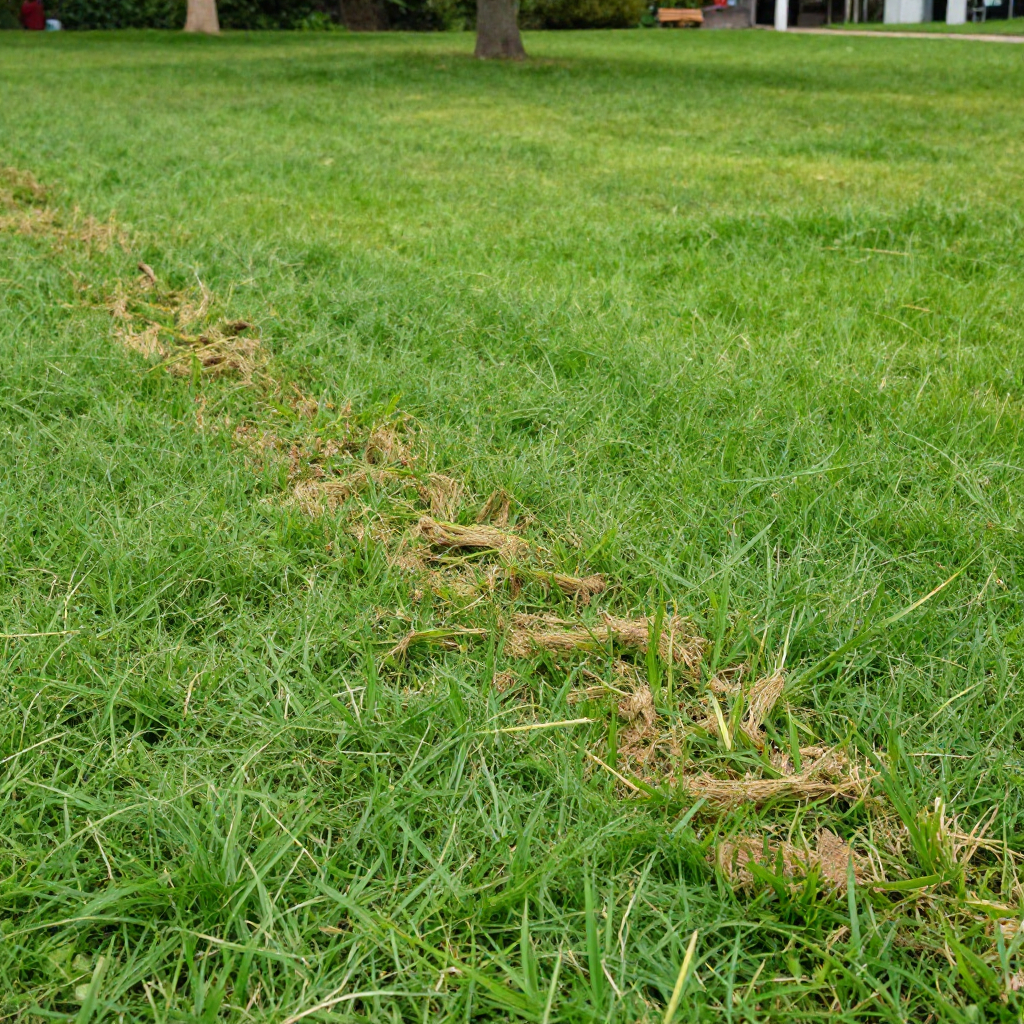
Kikuyu is an aggressive grower. Over time, the dense mat of old, dead runners beneath the living leaf layer — known as thatch — becomes a problem. A thatch layer thicker than 15 mm prevents water from reaching the soil, blocks fertiliser uptake, and creates an uneven surface that scalps under the mower.
Scalping — cutting too low into the thatch — exposes brown, dead material and shocks the grass. Many homeowners see scalped patches and assume disease or pest damage. In reality, an unmaintained thatch layer is the cause.
Regular dethatching (scarifying), combined with lawn dressing, keeps Kikuyu in balance. LawnKing’s guide on lawndressing Kikuyu grass in spring covers exactly how to do this effectively before the growing season begins.
4. Lawn Pests — Especially Lawn Grub
Lawn grub (the larvae of various beetle species) feeds on Kikuyu roots just below the soil surface. The damage appears as yellow or brown patches that pull away from the soil like a loose carpet — because the roots have been eaten.
Grub damage typically peaks in late summer and autumn. By the time brown patches appear, the infestation has often been active for weeks. Untreated grub damage can kill large sections of lawn within a short period. Early detection — checking for soft, spongy patches or increased bird activity — is crucial.
Fungal diseases like dollar spot, brown patch, and the aptly named Kikuyu yellows also cause distinctive circular or spreading damage patterns. These spread rapidly in warm, humid conditions — exactly what Randburg’s summer afternoons provide. The Silverstone Gardening guide on Kikuyu notes that summer patch, caused by soil-borne fungi, can kill roots and make the grass highly susceptible to further stress.
5. Nutrient Deficiency and Poor Feeding Schedules
Kikuyu is a heavy feeder. It consumes nitrogen rapidly during its growing season, and a lawn that is not fed regularly will yellow, thin, and lose the density it needs to resist weeds and pests. Many homeowners fertilise once in spring and assume that is sufficient. It is not.
Nitrogen applications every six to eight weeks during the growing season are typically needed to keep Kikuyu dense and green in Randburg conditions. Without consistent feeding, the lawn becomes thin — and thin Kikuyu is far more vulnerable to every other problem on this list.
For practical tips on seasonal nutrition and care, LawnKing’s Kikuyu grass summer survival guide outlines what the grass needs to stay healthy through Gauteng’s most demanding months.
6. Load Shedding and Irrigation Failures
This is a uniquely South African problem. Load shedding disrupts automated irrigation systems, causing missed watering cycles at the most critical times. A lawn that misses irrigation during a week of 35°C heat in January can suffer irreversible root damage within days.
Even homeowners with the best intentions and the most diligent care find themselves losing entire lawn sections because of infrastructure failures outside their control. This reality has accelerated the shift toward low-maintenance alternatives across Randburg and Midrand.
Why Kikuyu Repairs Become a Never-Ending Cycle
The Patching Problem
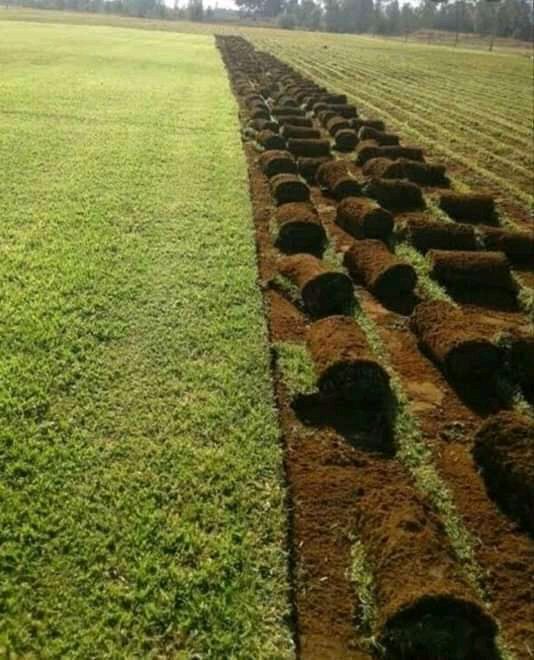
Most homeowners who ask “Why does my Kikuyu grass keep dying?” have already tried patching. They relay sections, feed heavily, water carefully — and the same patches die again the following season. This is because the underlying causes (compacted clay soil, frost pockets, poor drainage, or structural shade) are not addressed by simply replacing the surface grass.
Patching Kikuyu is possible, and LawnKing’s guide on repairing bare patches in your Kikuyu instant lawn provides a thorough process for doing it correctly. However, unless the root cause is fixed, bare patches will return.
The Cost of Ongoing Maintenance
A healthy Kikuyu lawn in Randburg requires regular mowing, seasonal dethatching, consistent fertilisation, pest monitoring, and adequate irrigation. When you add up the cost of water, fertiliser, pest treatments, and professional services, natural grass is far more expensive to maintain than most homeowners initially expect.
Furthermore, the aesthetic result is often inconsistent — a patchwork of different shades and densities rather than the uniform green carpet that photographs of Kikuyu lawns promise.
The Permanent Solution: Artificial Grass in Randburg
Why More Randburg Homeowners Are Making the Switch
Growing numbers of homeowners in Randburg and Midrand are choosing artificial grass precisely because they are exhausted by the Kikuyu cycle. They want a green, lush-looking garden without the water bills, the repair cycles, the pest treatments, and the seasonal brown-out.
Artificial grass from LawnKing eliminates every single problem listed above. It does not go dormant in winter. It does not need watering. Frost cannot damage it. Load shedding does not affect it. There are no lawn grubs, no thatch, no scalping, and no pH adjustments needed.
LawnKing Gardens offers a range of high-quality artificial grass products suited to Randburg’s conditions, including 25mm artificial grass for a natural, dense look and 30mm artificial grass for a lush, soft finish that works beautifully for family gardens, pet areas, and entertainment spaces.
All fibres are UV-stabilised to withstand Gauteng’s intense sunlight without fading. This means the lawn stays vibrant and green year-round — regardless of rain, frost, or drought.
Artificial Grass Is Ideal for Randburg’s Specific Challenges
Randburg’s clay soil and poor drainage are non-issues with artificial grass, because a proper installation includes a compacted sub-base and drainage layer that handles even the heaviest summer downpours. Water runs straight through, preventing pooling and eliminating the waterlogging that destroys Kikuyu roots.
Shaded areas — another place where Kikuyu consistently fails — are no problem at all for artificial grass. It looks identical in full sun and deep shade. This makes it the perfect solution for gardens with established trees or covered entertainment areas where no natural grass will ever grow reliably.
For roof terraces, balconies, and decks, LawnKing’s artificial grass for roofs, decks, and patios brings the same lush finish to spaces where soil-based lawn is completely impossible.
The Environmental Argument for Artificial Grass in Gauteng
Water is a scarce resource in South Africa. Gauteng experiences regular drought cycles, and the reality of Level 3 and Level 4 water restrictions means that keeping a natural lawn green during dry summers is increasingly incompatible with responsible water use.
Switching to artificial grass eliminates lawn irrigation entirely. Over the 10-to-15-year lifespan of a quality artificial lawn, the water savings are substantial — both financially and environmentally. For Randburg and Midrand homeowners committed to sustainable living, this is no small consideration.
Is Artificial Grass Right for Your Randburg Home?
What to Consider Before You Decide
Artificial grass is not the right choice for every application. It is not suitable for pastures, edible gardens, or large areas used primarily for absorption planting. However, for the typical Randburg residential lawn — 50 to 500 square metres of lawn used for family activities, pets, and aesthetics — it is an outstanding long-term investment.
The upfront cost is higher than laying instant Kikuyu. Nevertheless, when you factor in zero water costs, zero fertiliser, zero pest treatments, and zero relaying over a decade, the total cost of ownership tilts firmly in favour of artificial grass.
LawnKing Gardens serves Randburg and Midrand with professional supply and installation. Their team handles everything from sub-base preparation to final finishing — ensuring a result that looks natural, drains correctly, and lasts for years without the maintenance burden.
Final Thoughts: Stop the Kikuyu Cycle for Good
If your Kikuyu grass keeps dying in Randburg, the honest answer is this: the problem is rarely the grass alone. Randburg’s climate, soil, water restrictions, and load shedding create conditions that stretch Kikuyu beyond what regular maintenance can overcome.
You can continue to repair, relay, and re-treat — and there are good resources to help you do that well, including LawnKing’s comprehensive Kikuyu care guide. However, if you are tired of the cycle, artificial grass offers a permanent, beautiful, and genuinely low-maintenance alternative that Randburg’s conditions cannot defeat.
Recent Posts:
- Does Artificial Grass for Sports Fields Meet SAFA Standards in South Africa?
- What Thickness of Rubber Wet Pour Is Required for Different Playground Equipment Heights?
- How Do You Clean and Sanitize Rubber Wet Pour Surfaces in Public Playgrounds?
- What Drainage Solutions Are Needed for Artificial Grass Fields in Johannesburg?
- Is Rubber Wet Pour or Artificial Grass Better for High-Traffic Playground Areas?